Innovative Mosquito Reduction
Innovative Mosquito Reduction (IMR) focuses on using the latest technology available to protect public health by reducing the population of the most dangerous animal on the planet, the mosquito. As the Contra Costa Mosquito and Vector Control District (District) has been working for almost 100 years to fight the bite — the District has looked to innovation to help protect public health for just as long.
Drones
The District’s current innovative work involves the use of Drones to "Fight the Bite."
For years, the only way to deal with areas that have large amounts of water, like pastures and agricultural fields where rainwater or intentional flooding can create large areas of nutrient-rich water, was for District employees to spend hours walking back and forth on large water-logged fields looking for signs of mosquitoes. Today, however, innovation has created a solution — Unmanned Aircraft (UAS), or as they're commonly known, drones.

How Drones are Used to Protect Public Health
Drones are being used by an increasing number of public health agencies, including the District, to visually assess large agricultural and environmentally sensitive areas for mosquito production, while reducing potential impacts to those locations. Wetlands and other hard-to-reach places take just minutes to evaluate with a drone as opposed to hours on foot. Drones can also be used to apply public health pesticides to large areas much faster, more precisely, and can provide more focused treatments to very specific locations while following all applicable FAA laws and label requirements.
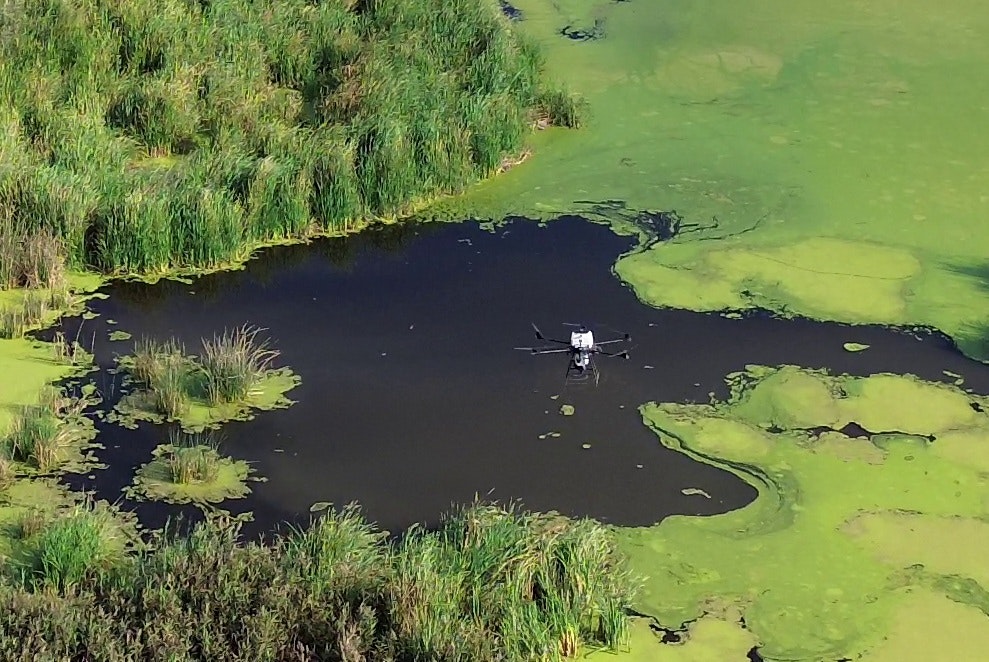
It's important to note that the District only uses drones in public areas such as fields, wetlands, and parks, at times when people are not present within the treatment area. The District does not use drones directly above residential areas.
Drones are an innovative way to fight the bite, particularly when it comes to areas not easily accessed by District employees, when working to reduce the risks associated with Contra Costa County’s 23 native mosquito species.
To learn more about drones, click here.
Releasing Infertile Male Mosquitoes
Female mosquitoes feed on blood and, if infected with mosquito-borne viruses, they can cause potentially serious or fatal illnesses. Male mosquitoes do not bite and therefore cannot transmit viruses to people, pets or wildlife.
In 2013, a new mosquito arrived in California, and quickly spread throughout the State. That mosquito, Aedes aegypti, can spread the viruses that cause Zika, dengue fever, yellow fever and chikungunya. This mosquito is well-adapted to urban residential neighborhoods and easily spreads to new areas as people travel from one area to another. Unlike most of our native species, which prefer larger water sources, this mosquito prefers small to medium-sized water-filled containers often found in our backyards, which are difficult to find and treat. That’s why mosquito abatement and mosquito and vector control agencies across the state have been looking for innovative ways to reduce the population of these invasive (non-native) mosquitoes.

One innovative technique, which was first developed in the 1960s to control cattle parasites, is irradiation. When males of the pest species are briefly exposed to X-rays or other forms of radiation in a laboratory, they become infertile, without becoming radioactive themselves. These infertile males are then released in large numbers to mate with wild females, and the resulting eggs fail to hatch, thereby reducing the population over time. Did you know: Sterilizing male insects by irradiation has been done since the early 1960s to control the screwworm fly (a serious cattle parasite) in the southern United States and Mexico.
Another innovation involves exposing lab-reared male mosquitoes with a specific strain of the bacterium Wolbachia, which grows naturally in mosquitoes and other insects, but is harmless to people and non-target insects. These male mosquitoes are then released to mate with wild females, which carry a different and incompatible strain of the same bacterium. Due to this incompatibility, the eggs produced by those females fail to hatch reducing the population of these dangerous mosquitoes over time. Since male mosquitoes do not bite or transmit diseases, they pose no risk to people or pets. This method is considered environmentally sound and can reduce the need for conventional public health pesticide treatments.
For more information on these innocations in mosquito control, check out videos on Innovative Technologies and Wolbachia-Treated Male Mosquitoes.
During the District’s nearly 100 years of protecting public health and serving the people of Contra Costa County, it has continuously introduced innovations designed to make mosquito control more efficient, effective, and environmentally safe, and there’s no doubt that there will be more innovations to "fight the bite" in the future.